
A sense of nervous excitement. Apparent is the frosty air emanating from my competitors as they execute the "starting line" wiggle on the beginning point.
A rapid flick of the hips.
I'm participating in my local 5km community parkrun and I'm serious. The countdown begins...
Wait a second. I need to start my device. As does the runner alongside me.
The person waiting expresses impatience. I refuse to go until… yes! Signal acquired, away I go.
During the scramble, it's hard to see a person without a smartwatch on it. And it's not just us participants who use them.
We're witnessing a thriving, multi-billion pound market. Names like Samsung Galaxy are prevalent, all offering an extensive selection of various devices to suit a range of lifestyles. Based on how advanced the device you select, price tags can start from £100 to a small fortune.
"It makes me crazy, I can't stop checking."
"It comforts me… It feels like a friend guiding me."
"Please don't notify me I've had a poor sleep."
A handful of the reactions I've had from other device users when I ask what they their opinion is on theirs.
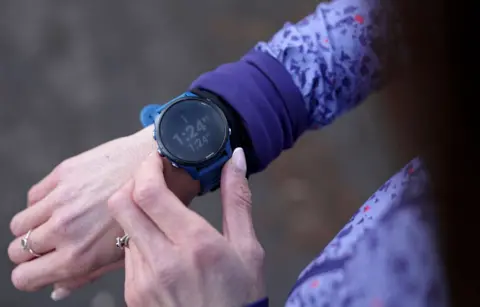
The Data Dilemma
My feelings on my own device? Right now, irritating. It's reporting my speed is wrong, leading me to doubt whether the overhead branches along my route are disrupting my satellite signal.
Countless individuals of us strap these compact gadgets onto our arms and keep them on 24/7, ostensibly unconcerned with the fact they're perpetually monitoring us.
A distant memory are the days when we relied on them exclusively to give us an estimation of our step count. Now, they can measure our sleep quality, stress levels, heart rate variability (HRV), our recovery score.
It's a challenge to find a physical metric they fail to monitor.
But can they do what they say they do? And are the statistics we obsess over a true reflection of our actual health? Do they improve our overall health, or do the plethora of metrics and cheerleading alerts just contribute to our daily stresses?

A Complicated Bond
"I become a a little preoccupied with mine," an individual reveals.
While she loves how her device records her workouts, she finds some of its other capabilities "excessive" at times - a feeling first discovered during a major life event.
Until she found out she could put it into a specific mode, her smartwatch kept telling her she was failing to be energetic enough. Now, the watch keeps telling her she's had a restless night.
"I've got a six-month old, it's unnecessary for me to be told I'm tired," she says. "I'm acutely aware all too clearly."
Why doesn't she just remove it?
"I could, I suppose, but I have this push-pull dynamic with it," she explains. "I value it for its workout tracking, I sometimes question whether the additional features it can now do is possibly too much for me."
How Do They Work?
Every device of smartwatch has its own unique way of measuring your health metrics and processing your data, but the most use optical sensors on the back of the watch.
They usually emit small, green LED lights onto your skin which can monitor blood flow, identifying your BPM. Sophisticated devices measure changes in the electrical current that runs through the skin to assess your nervous system activity.
Expert Perspectives
One expert says that overall for smartwatches, it's a "delicate equilibrium" - while the continuously improving tech could actually prevent illness, "spotting abnormalities before we show symptoms", it could also turn us device users into the "worried well".
He points out that the most advanced wearables can conduct tests like medical-grade monitoring, which regularly monitor how stable the heart is. They can alert if someone is experiencing atrial fibrillation (AF), where there is erratic impulses in the heart causing an irregular heartbeat.
This does not necessarily indicate someone is on the verge of a heart attack, but it can give an preliminary indication they might be more susceptible of a stroke in the future.
But how to interpret these readings is complex. The expert worries that as further capabilities are introduced, people may find it hard to fully understand their data.
"I'm not entirely convinced that being able to monitor so many metrics is such a positive development," he says.
A health researcher specialising in wearable tech concurs. Her work into the influence of wearable tech on a set of heart condition patients suggested a minority of those who were given devices to monitor their condition experienced greater stress and were "had a higher tendency to use medical services".
She identified a vicious circle with her patients - they saw a alarming metric on their watch. They felt anxious. Their pulse went up. They got even more concerned. They checked again, and their heart rate increased again.
"Upon viewing data about ourselves that we lack context for then, of course, we are going to become concerned," the psychologist says. "We check, we obsess - it becomes a feedback loop."

